
AI Agents vs. Workflows: Not Everything With an LLM Is an AI Agent
"If an LLM sends an email after answering a question, is that an AI agent?"
The answer is usually no.
Over the past year, the word agent has become one of the most overused terms in AI. Product announcements, startups, and even enterprise software vendors describe almost everything as an AI agent.
But there is a considerable difference between a workflow and an autonomous agent.
Understanding that difference can help you decide when you actually need an AI agent — and when a simple workflow is the better engineering choice.
Let's start with a workflow
Imagine you're building an employee IT assistant.
An employee asks:
"Reset my VPN password."
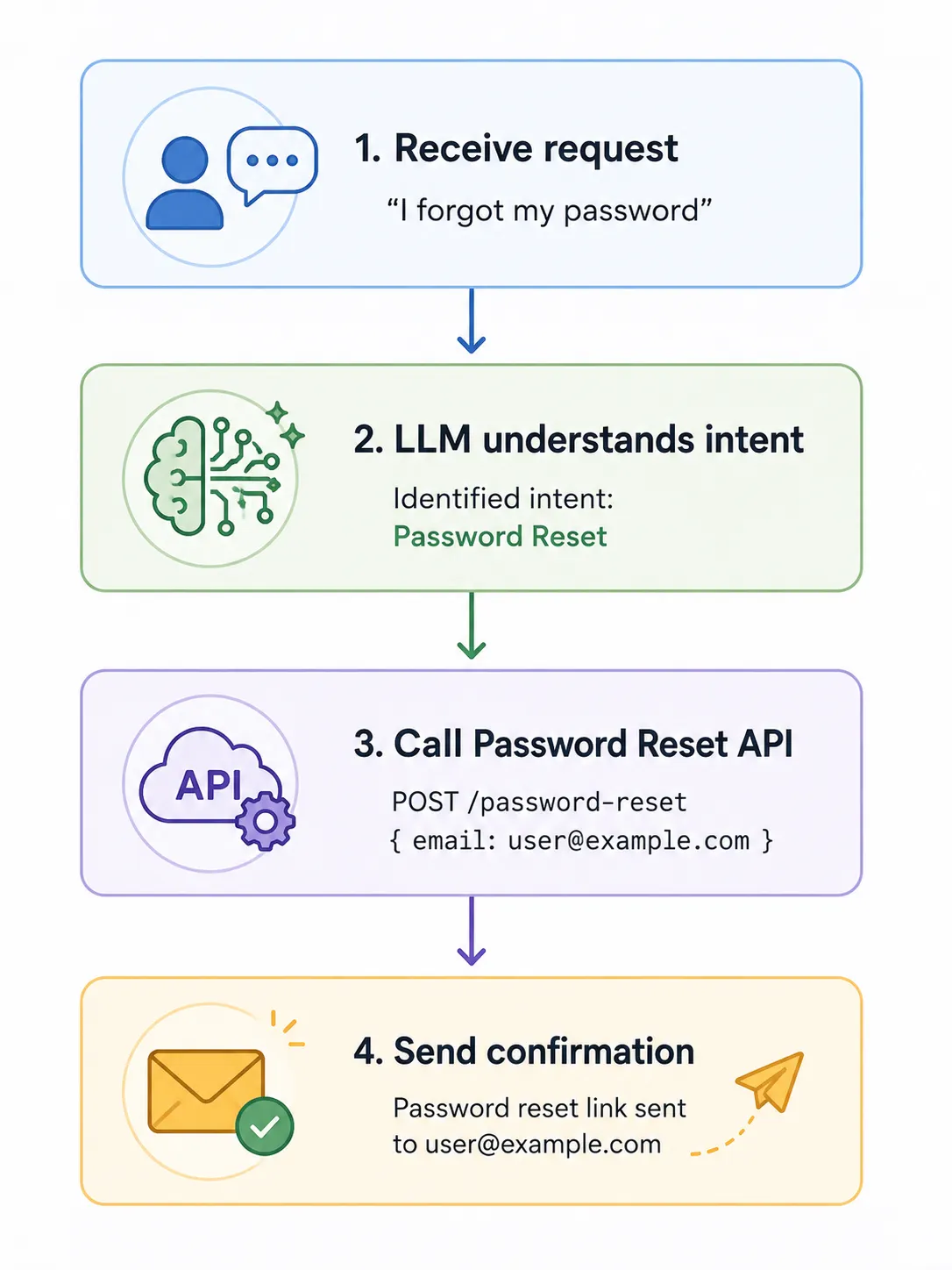
The LLM's job is simply to understand what the user requires.
It doesn't decide what to do next.
It doesn't make plans.
It doesn't explore alternatives.
It follows a predetermined path.
That's a workflow.
What makes an AI agent different?
Now imagine a different request.
"I can't access any company applications."
The problem could be:
- VPN
- Expired password
- MFA failure
- Disabled account
- Network outage
- Device compliance
No engineer has explicitly defined every possible sequence.
Instead, the AI must determine:
- What information do I need?
- Which systems should I check?
- Which tool should I call first?
- Did that solve the problem?
- If not, what should I try next?
Instead of following a script, it continuously reasons about the next action.
That is much closer to an AI agent.
A simple analogy
Imagine ordering food.
Workflow
A vending machine.
You press B4.
It gives you chips.
Same steps every time.
AI agent
A personal assistant.
You say:
"I'm hungry, but I don't want anything spicy, and I'd like to stay under $20."
The assistant thinks:
- Compare restaurants
- Check their delivery time
- Look at the reviews
- If everything looks good, order the food
- If one restaurant is closed, find another
The path isn't predefined.
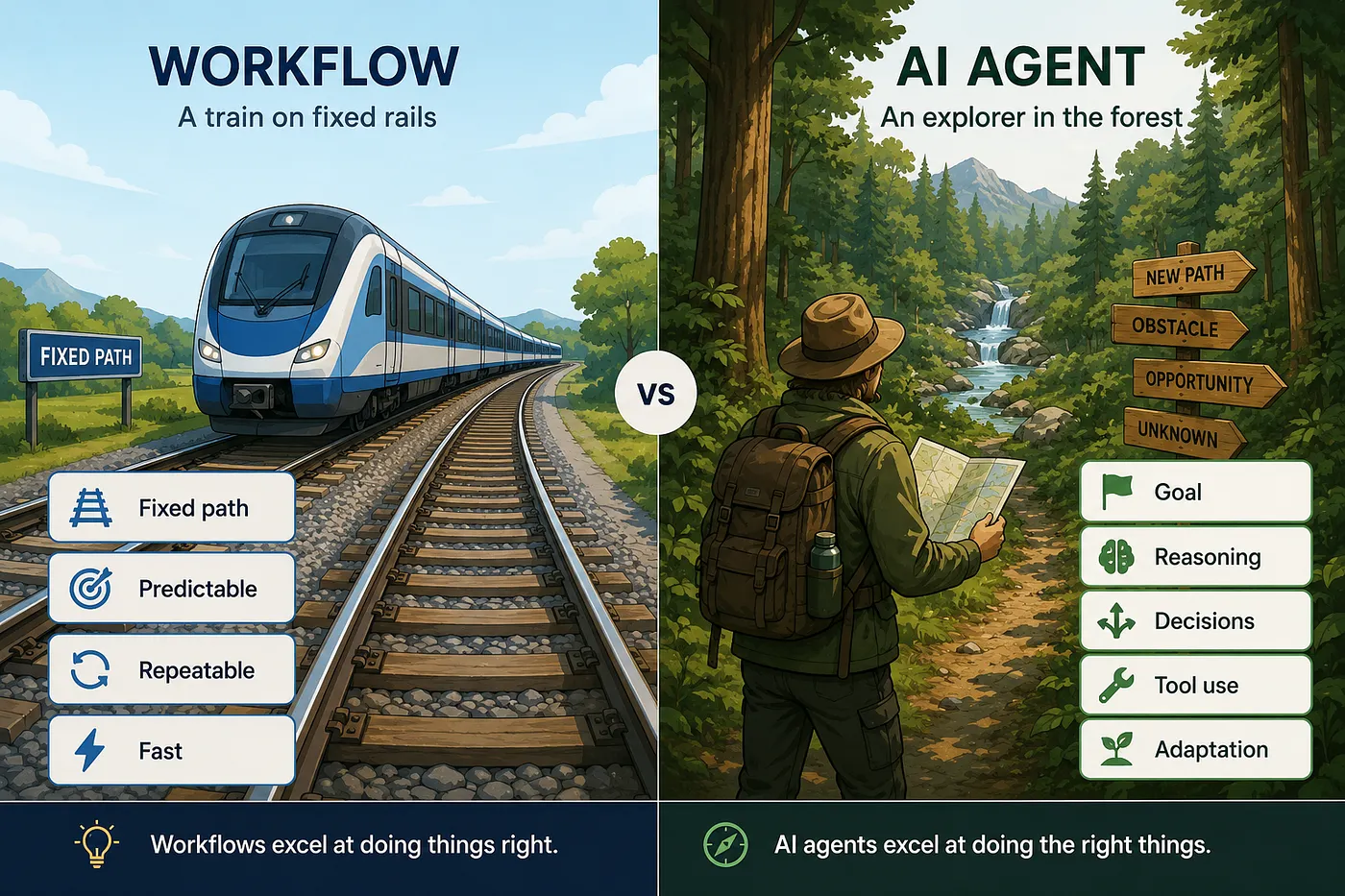
The biggest difference
A workflow executes instructions.
An agent decides what the instructions should be.
That's the key distinction.
Why enterprises still love workflows
People often assume agents will replace workflows.
In reality, enterprises still rely heavily on workflows because they are:
- Predictable
- Easier to test
- Easier to audit
- Faster
- Less expensive
- More reliable
If you already know every step, a workflow is often the better solution.
When do agents shine?
Agents become valuable when:
- The path isn't known ahead of time
- Multiple tools may be needed
- Decisions depend on previous results
- The system must recover from failures
- The goal is defined, but the process isn't
Examples include:
- IT troubleshooting
- Sales research
- Customer support investigations
- Financial analysis
- Security incident response
- Travel planning
Can they work together?
Absolutely.
In fact, most enterprise AI systems combine both approaches.
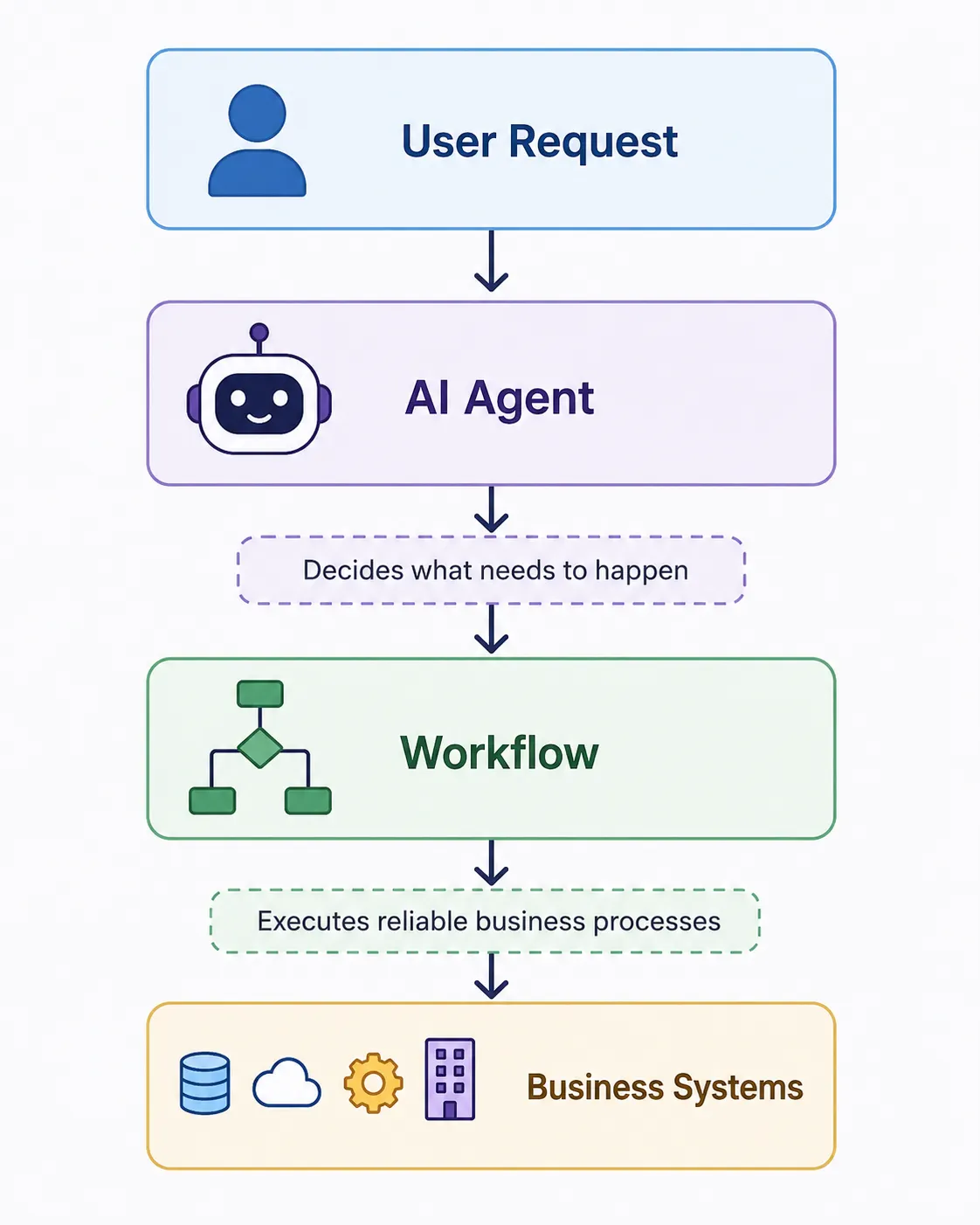
The agent handles reasoning. The workflow handles execution.
This gives you flexibility without sacrificing reliability.
Final thoughts
The question isn't whether AI agents are better than workflows.
It's whether your problem actually requires an agent.
If every step is already known, a workflow will usually be simpler, cheaper, and more reliable.
But when the destination is clear and the path isn't, that's where AI agents begin to show their real value.