
Dreamforce 2026: The Agentic Enterprise Meets Its ROI Reckoning
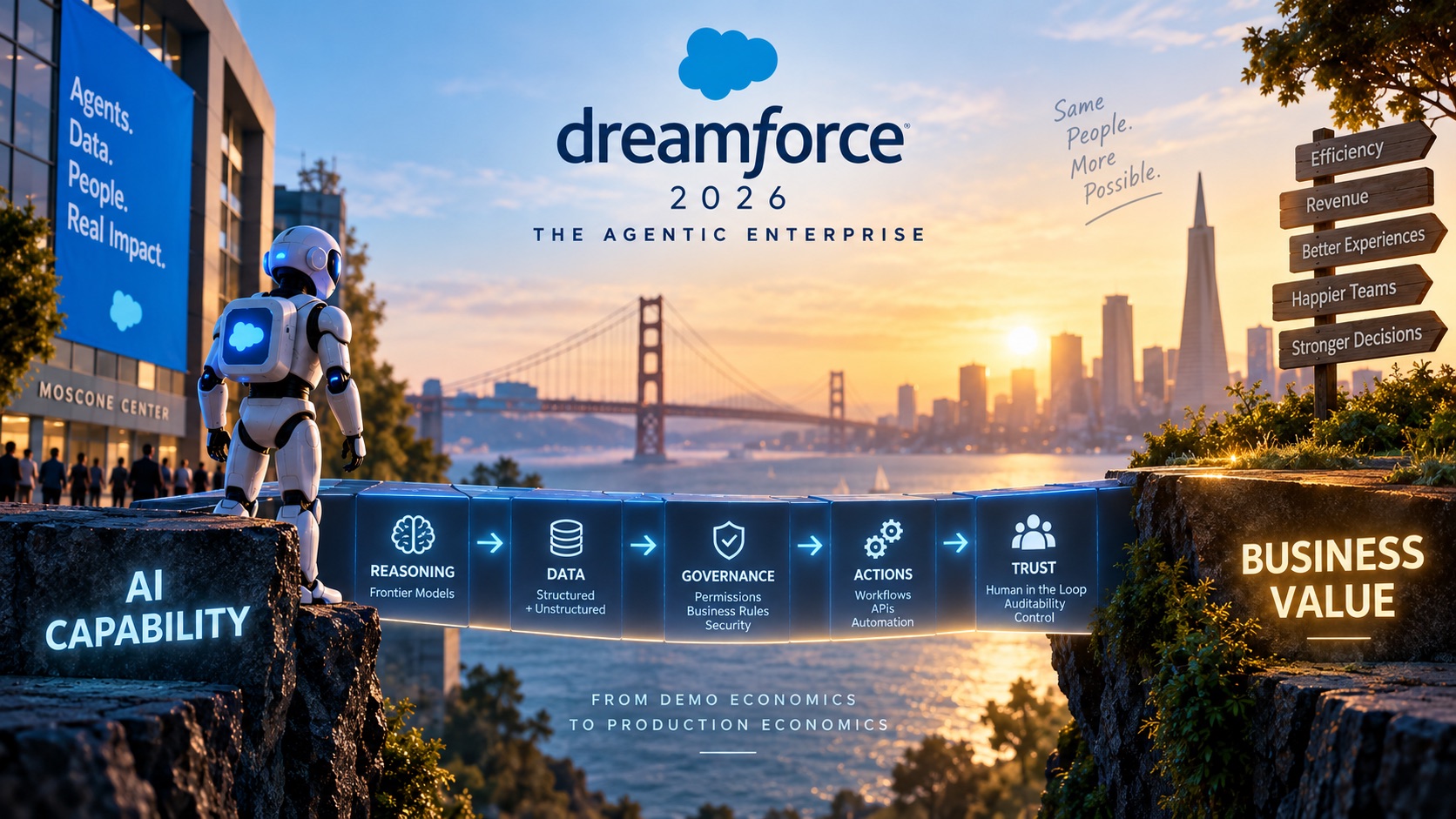
For the last two years, the enterprise AI conversation has mostly been about one thing: capability.
Can an agent answer a customer? Can it qualify a lead? Can it update CRM records? Can it reason across company data and take action?
At Dreamforce 2026, I think the question changes.
Was it worth it?
Dreamforce returns to San Francisco September 15–17, and Salesforce is pushing its biggest AI message yet: the Agentic Enterprise.
Agentforce is expanding. Data Cloud has evolved into Data 360. Salesforce and Anthropic have announced Claudeforce. And Marc Benioff will share the stage with Anthropic CEO Dario Amodei.
But enterprises are moving beyond being impressed that an AI agent can perform a task.
They now need to know what it costs to run that agent in production, how often humans still need to intervene, what happens when it gets something wrong, and most importantly, whether the business is actually getting a return.
That's what makes Dreamforce 2026 particularly interesting to me.
We may be entering the point where agentic AI has to move from demo economics to production economics.
A Bigger Show, A Bigger Bet
Salesforce certainly isn't thinking small.
Dreamforce 2026 includes more than 1,600 breakout sessions, 50-plus product and visionary keynotes, 150-plus hands-on trainings, and more than 240 community roundtables.
But behind all of that is really one big message: agents, data, and platform are converging into Salesforce's vision of the Agentic Enterprise.
Agentforce provides the agents.
Data 360 provides the context.
Salesforce provides the business platform and governance.
And now Claude brings another important piece: reasoning.
Claudeforce Changes the Conversation
On August 26, Salesforce and Anthropic announced an expanded partnership called Claudeforce.
There are plenty of interesting details in the announcement. Salesforce becomes Anthropic's preferred CRM, while Slack becomes Anthropic's preferred work platform. Claude is also moving deeper into the Salesforce ecosystem.
But what interests me isn't simply that Salesforce partnered more deeply with Anthropic.
It's what the architecture behind that partnership tells us.
Claude brings the reasoning.
Salesforce brings the enterprise context around it: customer data, workflows, business logic, permissions, actions, and governance.
That distinction matters.
Enterprises don't necessarily need their CRM vendor to build the smartest frontier model. They need access to great reasoning while making sure that reasoning operates inside the rules of the business.
The partnership also works in the other direction.
A new Salesforce in Claude capability allows Claude to work with Salesforce data, workflows, business logic, and governance through 37 pre-built skills tailored to sellers. It's currently available with select pilot customers, with an open beta planned for September.
To me, this points toward an interesting future for enterprise AI.
The intelligence layer may increasingly come from frontier model providers like Anthropic, while Salesforce's advantage is the governed enterprise layer underneath it: the data, permissions, workflows, business rules, and actions that determine what an agent is actually allowed to do.
And as reasoning models become more capable, those deterministic controls don't become less important.
They become more important.
A smarter agent can make better decisions. But it can also take more consequential actions when it's wrong.
Data 360: Better Reasoning Needs Better Context
The second piece is data.
Data Cloud has evolved into Data 360, with Salesforce positioning it as the context layer for the Agentic Enterprise, including information buried inside PDFs, emails, call transcripts, knowledge articles, and other unstructured enterprise content.
This is important because real business context is messy.
Imagine a support agent trying to resolve a customer problem.
The answer might not exist in a single CRM field. The agent might need the customer's account history, a previous support conversation, a product manual, an email thread, and perhaps a warranty document before deciding what should happen next.
An agent that can only reason over structured CRM records is useful.
An agent that can understand the broader context of the business is much more powerful.
But that introduces another problem enterprises will eventually have to solve:
How do you give an agent enough context to make a good decision without giving it access to everything?
Again, the conversation quickly moves from capability to governance.
Agentforce Is Becoming the Platform
Then there's packaging.
On September 3, Salesforce announced simplified Core, Advanced, and Max editions across Agentforce Sales, Service, and Industries, bringing capabilities such as Slack, Tableau Next, Premier Success, and enterprise security into broader bundles.
Packaging changes don't usually get much attention at events like Dreamforce.
I think this one deserves some.
Salesforce appears to be making a larger statement:
Agentic AI isn't another feature you bolt onto CRM. It's becoming part of the platform itself.
That could make adoption easier.
But it also makes another question increasingly important.
How do companies measure the economics of the agents running on that platform?
Show Me the Production Economics
We already know agents can do impressive things.
What I want to see now are the production numbers.
If an agent handles 100,000 customer conversations:
How many were actually resolved without a human?
How many required escalation?
What did those 100,000 conversations cost?
How often did the agent take an incorrect action?
How much human oversight was still required?
And what would those same interactions have cost without the agent?
Those are the numbers that turn an AI demo into a business case.
Because eventually a CFO isn't going to approve an agentic rollout because the demo looked impressive.
And a security team isn't going to approve one simply because the model appears intelligent.
They need measurable value, predictable costs, clear controls, and accountability when something goes wrong.
The enterprise AI conversation is moving from:
Can the agent do this?
to:
Should we let the agent do this?
And eventually:
Does letting the agent do this actually create enough value to justify the cost and risk?
That last question may be the hardest one.
What I'm Watching at Dreamforce
I'm going to Dreamforce this year, and there are three things I'll be watching closely.
First, the numbers.
I want to see production metrics behind Agentforce. Not just how many agents have been created or how many customers are experimenting with them, but what those agents are actually delivering.
Cost per interaction. Resolution rates. Human escalation. Time saved. Revenue generated. Errors prevented.
Second, Claudeforce in practice.
I'm interested in how deep the Claude integration actually goes, but even more interested in where Salesforce draws the boundary between model reasoning and deterministic enterprise controls.
Where does the LLM get to decide?
Where does Salesforce enforce the rules?
That boundary may ultimately matter more to enterprises than which model sits underneath Agentforce.
Third, the economics.
Does Salesforce's new packaging actually make it easier for companies to deploy agents at scale?
And once they're running thousands or millions of agent interactions, can companies clearly understand what those agents are costing them and what they're getting in return?
Salesforce has spent the last couple of years making the case that AI agents can become digital coworkers.
Dreamforce 2026 may be where customers start asking the next question:
What are those coworkers actually delivering?
The Agentic Enterprise pitch is compelling on stage.
Whether it's compelling on a purchase order is the story that actually matters this year.